
Content Optimization Is Dead. Here's What Replaced It.
Old keyword-density tools are dead. The category evolved into dual scoring, AI visibility tracking, and autonomous content fixes.
A Reddit thread in r/seogrowth asked: "Are you guys still using content optimization tools like Frase, Surfer, Scalenut?" The top answers were brutal. The tools make content less readable. They don't account for LLMs. They haven't progressed. One commenter said these tools "lack a LLM/Rankbrain/Gemini friendliness metric." Gemini 3's release made this concrete — see our 4-step recovery playbook for what to do when AI Overview citations rotate.
They were talking about my product, Frase.
Frase was a very powerful content optimization platform. It had research tools, content scoring, brand voice features, and we'd even added AI visibility tracking. But the core scoring model worked the same way every tool in the category worked: analyze top-ranking pages, derive keyword targets, give you a score to match. That approach had real limitations the Reddit critics identified correctly.
We rebuilt the product from scratch in January 2026. Not because the old Frase was bad, but because the market evolved to need AI visibility as a first-class citizen alongside search, not an add-on. That required a new foundation.
This piece explains what changed in search, why we rebuilt, and what content optimization tools look like when AI visibility is architecturally equal to SEO. If you wrote off the category based on the 2023 version, the product you evaluated and the product that exists today are different tools.
What you'll learn:
- Why the core criticism of content optimization tools was valid
- Three structural shifts that made the old scoring model obsolete
- Why we rebuilt Frase with AI visibility as a first-class citizen
- What GEO scoring, Content Guard, and agentic workflows actually do
- A framework for evaluating whether any platform has made this transition
Why the Skeptics Were Right
The original content optimization tools had a simple premise: analyze the top 20 or 30 Google results for a keyword, count what terms they used and how often, then give you a target score to match.
Hit the target content score. Use your keyword a dozen times. Include several semantically related terms. Publish. Wait for rankings.
Every tool in the category did this, including Frase. The tools had real capabilities beyond keyword counting (research, brand voice, content briefs) but the core scoring model was the same everywhere. Between 2018 and 2022, matching the topical pattern of top-ranking pages was a legitimate strategy. But it created homogeneous content. Every page targeting the same keyword converged on the same structure, same depth, same terms.
Google's Helpful Content Update in 2022 and 2023 penalized sites that prioritized search-engine-first content over genuine expertise. MUM in 2021, then Gemini in Search in 2024, meant Google could evaluate content quality at a deeper level than term frequency.
The critics were right about the scoring model: counting keyword frequency and comparing it to a SERP average was never going to survive a search engine that can read for meaning. The tools did more than that, but the scoring model was the foundation, and that foundation cracked.
Three Shifts That Broke the Old Model
Between 2024 and 2026, three structural changes in search made the old content optimization approach irrelevant. Understanding these shifts explains why the category had to evolve.
Shift 1: AI Search Engines Emerged as Citation Platforms
ChatGPT, Perplexity, Google AI Overviews, Claude, and Gemini don't rank pages. They synthesize answers and cite sources. When someone asks Perplexity "what's the best way to optimize content for search," it doesn't return 10 blue links. It writes a response and attributes specific claims to specific URLs.
This is a fundamentally different discovery mechanism. Instead of competing for position 1-10, your content competes for citation inclusion.
The scale is significant. AI-referred sessions grew 527% between January and May 2025, according to Previsible's analysis of 19 GA4 properties reported by Search Engine Land. Similarweb's Generative AI Report measured 1.13 billion referral visits from AI platforms in June 2025 — a 357% increase year over year. ChatGPT alone drives 87.4% of that AI referral traffic.
AI referral traffic is still a fraction of total organic search. But the growth trajectory is vertical, and as we'll see, the conversion quality is dramatically higher. A content optimization tool that only scores for Google rankings is blind to this entire surface.
Shift 2: Zero-Click Search Crossed the Majority Threshold
More than 58% of Google searches now end without a click to any website. For queries that trigger AI Overviews, the zero-click rate reaches 83%.
Google AI Overviews now appear on nearly half of tracked queries in the US, roughly double the coverage from a year earlier. When the majority of searches don't produce clicks, your content has to deliver value in contexts where the full page is never loaded. The old approach optimized for getting the click. The new requirement is getting the citation.
Shift 3: AI Search Traffic Converts at Dramatically Higher Rates
Here's the counterintuitive part: despite lower traffic volume, AI referral traffic is far more valuable per visit. Analysis of 13 months of LLM traffic data published by Search Engine Land shows AI search traffic converts at 14.2%, compared to Google organic traffic at 2.8%.
That conversion premium exists because AI search pre-qualifies the visitor. By the time someone clicks through from a Perplexity citation or a ChatGPT source link, they've already read a synthesized answer that included your content as authoritative. The click is intentional, not exploratory.
Ignoring AI search isn't leaving citations on the table. It's leaving the highest-converting traffic source in search unaddressed.
These three shifts compounded. By mid-2025, content teams faced a different optimization problem than the one the 2023 tools were built to solve: two surfaces, two sets of signals, and a scoring model that could only see one of them.
Why We Rebuilt Frase
We tried the bolt-on approach first. We added AI visibility tracking to the old Frase. It worked, technically. But AI visibility as a feature bolted onto an SEO-first architecture is different from AI visibility as a first-class citizen alongside search. When AI visibility is an add-on, every product decision still centers on Google rankings. When it's foundational, every feature (scoring, monitoring, optimization, agent workflows) can leverage both surfaces equally.
That's the architectural decision that forced the rebuild. Frase relaunched in January 2026 with AI visibility architecturally equal to search. Here's what that means in practice.
Dual Scoring: SEO and GEO as Equals
The Reddit thread said content optimization tools "lack a LLM friendliness metric." The commenter was right that no tool scored content specifically for AI citation likelihood. That's what GEO scoring is.
Generative Engine Optimization (GEO) is the discipline of optimizing content for AI citations. A study by researchers from Princeton, IIT Delhi, and the Allen Institute for AI, published at ACM SIGKDD 2024, established that specific optimization techniques can improve content visibility in AI-generated responses by up to 40%. The most effective techniques: adding cited statistics (+33% visibility), incorporating authoritative quotations (+41%), and improving structural clarity. The least effective technique: keyword stuffing (-8.7%, actually harmful).
That last finding is worth emphasizing: the technique that defined the entire content optimization category for a decade, keyword stuffing, actively reduces your visibility in AI search. The old tools were training users to do the opposite of what works for AI citations.
That research informed what we built. GEO scoring in Frase evaluates entity density, factual specificity, structural clarity, and authority signals. It answers the question the old tools never asked: "If an AI search engine encountered this content, how likely is it to cite it?" Under the old model, optimized content was content that used the right words often enough. Under the GEO model, optimized content is content that an AI system would trust enough to quote. The bar moved from "does this match a keyword pattern" to "does this contain claims worth citing."
The critical design decision was dual scoring. You see an SEO score and a GEO score side by side as you write. The two surfaces reward different things. Google rewards comprehensive coverage and backlink authority. AI engines reward factual density, clear structure, and citable claims. A piece that scores 90 on SEO and 40 on GEO will rank on Google and be invisible to ChatGPT. Dual scoring catches that gap before you publish.
No other content optimization tool provides a separate GEO score in the editor. Some have added AI-aware features (Surfer's AI Search guidelines, Clearscope's AI term presence indicators) but none produce a dedicated GEO score alongside the SEO score. We checked this week.
AI Visibility as a First-Class Citizen
The old Frase had AI visibility tracking. But it was a feature you navigated to separately from the content workflow. In the rebuilt Frase, AI visibility is woven into every surface: research shows what AI engines cite for your target queries, scoring evaluates citation-readiness alongside SEO, and monitoring tracks your presence across ChatGPT, Perplexity, Claude, Gemini, Google AI Overviews, Grok, Copilot, and DeepSeek.
The difference matters operationally. When AI visibility is integrated, you discover that a competitor gets cited for your target queries across six platforms while you appear on zero. That's not a ranking problem. It's a content architecture problem that requires a different kind of optimization, one the old scoring model couldn't surface.
AI citations are also binary in a way Google rankings are not. Rank positions decline gradually. AI citations disappear overnight. A single competitor publishing a more comprehensive piece can remove you from AI responses with no warning. Without integrated monitoring, your Google rankings could hold steady while your AI citations evaporate.
Auto-Optimization: Scoring That Fixes What It Finds
Most tools in this space are adding monitoring. Semrush tracks visibility across nine AI platforms. Ahrefs Brand Radar analyzes hundreds of millions of prompts. These are real capabilities. But they end at the same point: here's your dashboard. Now go fix it manually.
The problem: 68% of websites lose organic traffic to content decay yearly, according to Ahrefs. For AI citations, the decay is faster: half of all AI-cited content is less than 13 weeks old. A site with 200 published articles needs 40-60 hours per quarter just for manual auditing. Most teams don't have that capacity, so content decays silently.
Content Guard closes the loop from monitoring to action. It works on three levels:
- Detection. Continuous monitoring identifies when content loses Google rankings, AI citations, or both.
- Diagnosis. The system analyzes why: competitor updates, outdated statistics, structural gaps, shifted query intent.
- Autonomous fix. Based on the diagnosis, Watchdog deploys targeted updates without manual intervention.
When I describe this to SEO practitioners, the first reaction is usually "I'd never trust automated changes to my content." That's reasonable. Content Guard isn't rewriting articles from scratch. It applies specific, targeted optimizations: the same changes a human editor would make if they had infinite time to monitor every page. Outdated statistics get refreshed. Citation formatting gets improved. Structural gaps get filled.
The content lifecycle is research, write, score, publish, monitor, fix. Any tool that covers only the first four steps leaves you exposed on the two that matter most for sustained performance. The new Frase treats publishing as the midpoint, not the finish line.
Agentic Workflows: MCP, CLI, and Platform Integration
The rebuilt Frase isn't a dashboard you log into. It's a platform that integrates with the tools content teams already use. MCP (Model Context Protocol) lets AI assistants like Claude Code and Cursor interact directly with Frase. The CLI enables scripted workflows. FraseCMS provides native publishing. The platform meets you where you work instead of requiring you to work inside it.
Frase's MCP server is read-write — an AI agent can research, draft, score, optimize, and publish through a single conversational interface. Semrush and Ahrefs offer MCP servers, but both are read-only. The traditional seven-tool, seven-context-switch workflow compresses into hours because the handoffs between steps are eliminated.
What the rebuilt platform covers versus the old one:
| Capability | Old Frase | New Frase |
|---|---|---|
| Content optimization + research | ✓ | ✓ (more powerful) |
| Brand voice | ✓ | ✓ (governance system) |
| AI visibility | Add-on | First-class citizen |
| GEO scoring (dual SEO + GEO) | ✗ | ✓ |
| Auto-optimization (Content Guard) | ✗ | ✓ |
| MCP + CLI + agentic workflows | ✗ | ✓ (read-write) |
| FraseCMS + platform integrations | ✗ | ✓ |
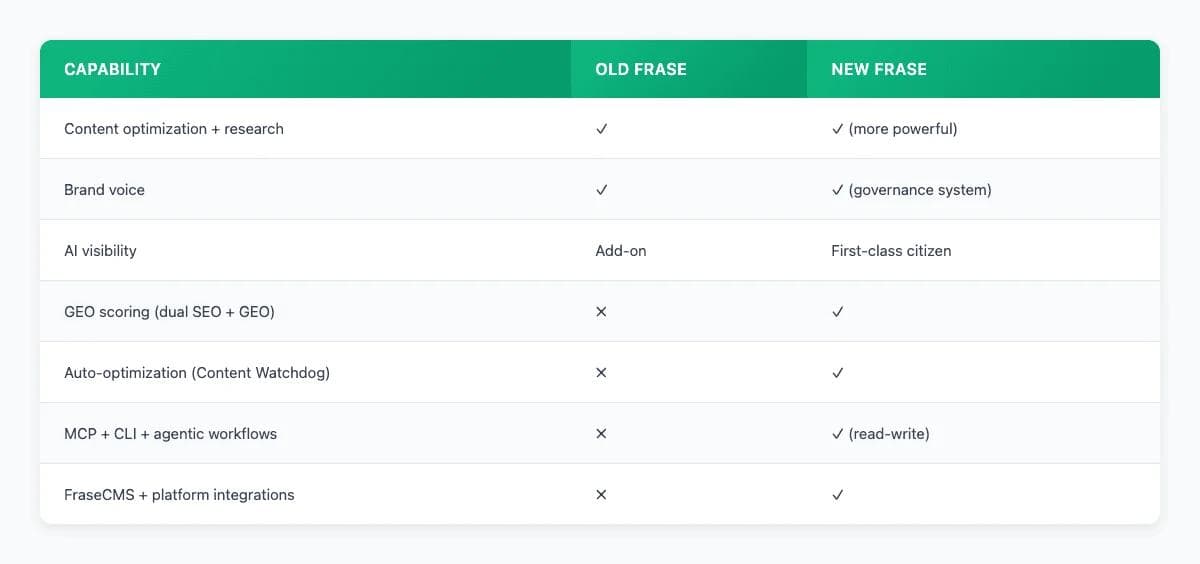
The jump isn't incremental. It's a different product solving a different set of problems.
How to Evaluate Whether Any Platform Made This Transition
We rebuilt Frase for the reasons described above. But the evaluation framework applies to any content optimization tool. These five questions separate 2023 holdovers from platforms that actually evolved.
1. Does it score for AI search, not just Google?
A tool that only provides an SEO score is solving half the problem. Look for dual scoring: GEO for AI citations alongside SEO for Google rankings. If you can't see how your content performs for both surfaces before publishing, you're guessing on the one that converts at dramatically higher rates. Ask the vendor to show you the GEO score in their editor. If they can't, they haven't built it.
2. Does it monitor your visibility across AI platforms?
After publishing, you need to know whether AI search engines are citing your content. A platform that tracks visibility across ChatGPT, Perplexity, Claude, Gemini, and other AI engines gives you the same competitive intelligence for AI search that rank tracking gives you for Google.
3. Can it fix problems, or just report them?
Monitoring that ends at a dashboard is useful but incomplete. When something decays, does the platform help you fix it, or just tell you about it? The gap between "here's your problem" and "here's your problem fixed" is where most of the operational cost lives.
4. Does it integrate with AI agents?
MCP integration is the new standard. If you're building workflows with Claude Code, Cursor, or other AI assistants, your content platform should be accessible from those environments. Read-write integration (not just read-only data pulls) enables the full lifecycle.
5. Does it cover the full lifecycle?
Research, write, score, publish, monitor, fix. A tool that handles only one step forces you to stitch together a fragmented workflow. A platform that covers the full lifecycle compounds efficiency at every stage.
No tool scores perfectly on all five. The market is evolving fast and every platform has tradeoffs. But the core question is whether the tool you're evaluating has crossed the threshold from keyword checker to content operating system. If it still scores content against SERP keyword frequency and stops there, it's a 2023 tool in a 2026 market.
For specific tool-by-tool comparisons, see our detailed Frase vs Surfer SEO breakdown. For a step-by-step guide to optimizing content for AI citations, see the complete GEO playbook.
Frequently Asked Questions
Are content optimization tools still worth it in 2026?
The tools that only matched keyword density to SERP averages are not. But content platforms that include GEO scoring, AI visibility tracking, and autonomous fixes address a different problem — getting cited by AI search engines, not just ranking on Google. The category evolved; the old criticism applies to the old product.
What is GEO scoring and why does it matter?
GEO (Generative Engine Optimization) scoring measures how likely AI search engines are to cite your content. It evaluates entity density, factual specificity, structural clarity, and citation formatting. Research from Princeton and IIT Delhi found these optimization techniques can significantly improve AI citation visibility.
How is GEO scoring different from traditional SEO optimization?
SEO scoring optimizes for Google's ranking algorithm: keyword placement, backlink authority, page speed, heading structure. GEO scoring optimizes for AI citation selection: entity density, factual specificity, quotable structure, and authority signals. Both matter. Modern content platforms score for both simultaneously.
What is Content Guard and how does it work?
Content Guard monitors your published content for ranking drops and AI citation decay, then deploys targeted fixes automatically. It detects the problem (traffic decline, lost citations), diagnoses the cause (competitor updates, outdated statistics, structural gaps), and applies optimizations without manual intervention.
Can AI agents handle content optimization automatically?
With MCP (Model Context Protocol) integration, AI agents can research, write, score, optimize, and publish content through a conversational interface. The agent handles execution while you provide strategic direction and review output. This works today through platforms that offer read-write MCP servers.
Which AI platforms should I monitor for content visibility?
Track citations across the eight major AI search surfaces: ChatGPT, Perplexity, Claude, Gemini, Google AI Overviews, Grok, Copilot, and DeepSeek. Citation patterns differ across platforms — content that Perplexity cites frequently may be absent from ChatGPT's responses.
Is Frase the same tool it was in 2023?
No. Frase was rebuilt from scratch and relaunched in January 2026. The old Frase was a capable content optimization platform, but AI visibility was an add-on feature. The new Frase treats AI visibility as a first-class citizen alongside search, with dual GEO + SEO scoring, auto-optimization via Content Guard, agentic workflows via MCP and CLI, and FraseCMS for native publishing.
How do I transition from a keyword-density tool to a full content platform?
Start with a site audit. A GEO-enabled audit shows you both your SEO performance and your AI citation readiness in the same view. This reveals the gap between what Google sees and what AI engines see, and prioritizes the content that needs the most attention. Start a free trial to run your first audit in under two minutes.
Content Optimization Tools in 2026: What We Learned
The Reddit commenter who said content optimization tools "lack a LLM/Rankbrain/Gemini friendliness metric" was describing a real limitation. The tools had strong capabilities (research, brand voice, content scoring) but the core scoring model couldn't see AI search.
What I learned from rebuilding: the gap between a tool that treats AI visibility as a feature and a platform that treats it as foundational is not a feature gap. It's an architectural gap. When AI visibility is a first-class citizen alongside search, every capability (scoring, monitoring, optimization, agent workflows) can leverage both surfaces. When it's an add-on, the product centers on Google rankings and treats AI as secondary.
Content now performs on two surfaces. The content optimization tools that address both are fundamentally different from the ones that addressed only one. Every tool in this category is making the same choice we faced: rebuild for dual-surface search, or keep iterating on a single-surface architecture.
The question isn't "are content optimization tools worth it?" The question is: can your content strategy survive without knowing whether AI search engines cite your work?
If you want to find out where you stand, run a free site audit. You'll see your score and fill the gaps to help your content rank and get cited.
About the author
Shegun Otulana
Founder & CEO
Shegun Otulana is CEO of Copysmith AI, parent company of Frase.io and Describely.ai. He's a serial entrepreneur with multiple exits and has been building companies at the intersection of search, marketing, SaaS, and artificial intelligence since 2013. Shegun writes about generative engine optimization, AI search, and the future of content marketing.
See Frase run on your own content.
Research your market, draft in your voice, and track where you show up across Google and AI search. Start free.
Start free trial7-day free trial. No credit card.