
What Is AI Visibility? The Complete Guide to Getting Cited by AI Search Engines (2026)
AI visibility is how brands get cited in ChatGPT, Perplexity, and Google AI Overviews. Learn how to measure, track, and improve your AI search presence.
AI visibility is the practice of monitoring and improving how often your brand appears in AI-generated answers from ChatGPT, Perplexity, Google AI Overviews, and other AI search engines. Unlike traditional SEO visibility (which measures search rankings), AI visibility tracks whether AI engines cite your content when users ask relevant questions.
The scale of this shift is massive. ChatGPT now has 910 million weekly active users, while Google AI Overviews reach 2 billion monthly users across 200+ countries. These platforms are fundamentally changing how people discover brands and consume information.
Yet most marketing teams have no idea whether AI search engines mention them at all.
This guide covers everything you need to know about AI visibility in 2026:
- What AI visibility is and how it differs from traditional SEO visibility
- Why AI visibility matters for your brand's future growth
- How AI engines decide which sources to cite
- How to measure and track your AI search presence
- Which tools can help you monitor AI visibility
- Proven strategies to improve your citation rates
- Industry-specific considerations and a 90-day implementation roadmap
Whether you are a content marketer, SEO professional, or digital strategist, understanding AI visibility is now as essential as understanding answer engine optimization and keyword rankings.
What Is AI Visibility?
AI visibility is the measure of how frequently and prominently your brand, content, or website appears in responses generated by AI-powered search engines and assistants. It encompasses every instance where an AI platform cites your content, mentions your brand name, or recommends your product when a user asks a relevant question.
Think of it this way: traditional SEO visibility answers the question "where do I rank in Google's results?" AI visibility answers a different question entirely: "does the AI mention me when someone asks about my topic?"
How AI Visibility Differs from Traditional SEO Visibility
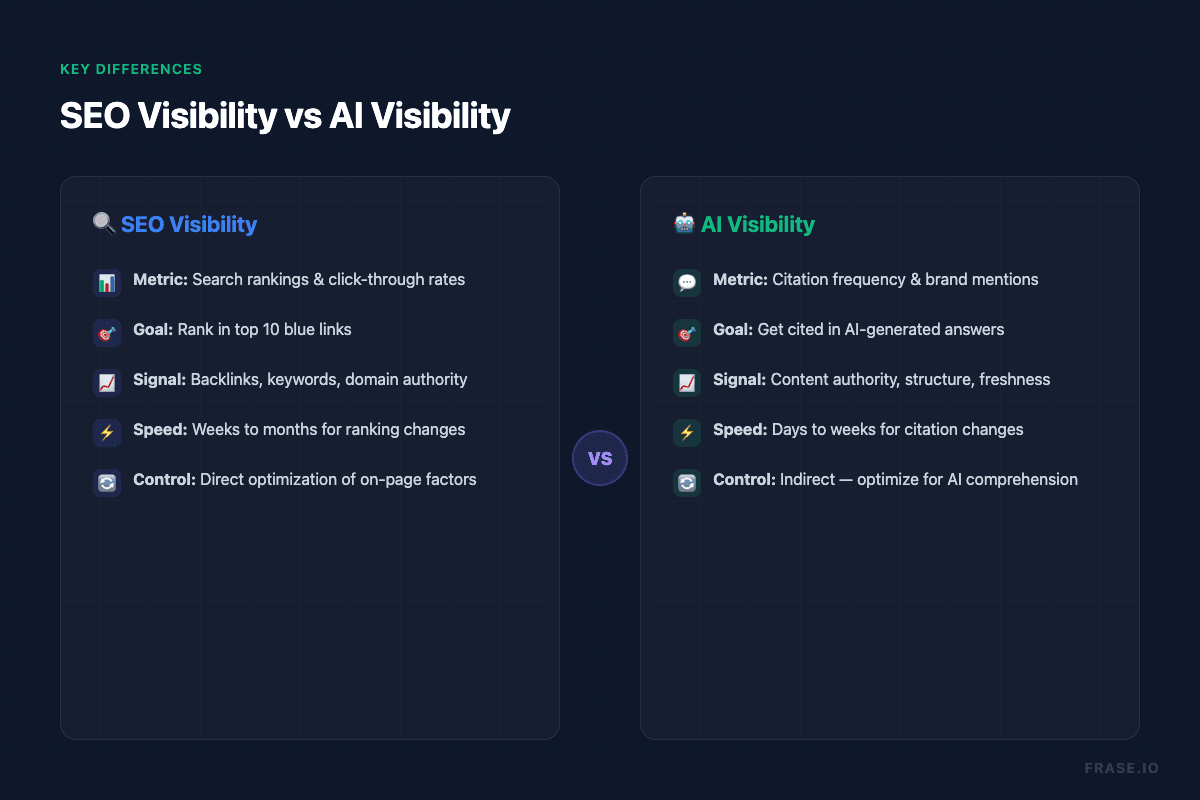
The difference between these two forms of visibility is fundamental, not cosmetic.
Traditional SEO visibility operates on a ranking model. Your content competes for positions 1 through 10 on a search results page. Users scan headlines, click a link, and visit your website. You measure success through rankings, click-through rates, and organic traffic.
AI visibility operates on a citation model. AI engines synthesize information from multiple sources into a single answer. Your brand either gets cited in that answer or it does not. There is no "position 7" in an AI-generated response. You are either visible or invisible.
This table illustrates the core differences:
| Factor | SEO Visibility | AI Visibility |
|---|---|---|
| Primary metric | Search ranking position (1-10) | Citation presence (yes/no) |
| User action | Click through to website | Read answer in-platform |
| Content format | Optimized web pages | Cited source in synthesized answer |
| Success signal | Higher ranking = more clicks | More citations = more brand exposure |
| Competitive frame | 10 spots on page one | Unlimited citations per answer |
| Update cycle | Algorithm updates (periodic) | Model retraining + real-time search |
| Traffic impact | Direct website visits | Brand awareness, indirect traffic |
| Measurement tools | Google Search Console, Ahrefs, Semrush | AI visibility platforms, manual monitoring |
The Shift from "10 Blue Links" to AI-Generated Answers
Google's traditional search results page is being redesigned around AI. As of February 2026, 48% of tracked queries now trigger AI Overviews, representing a 58% year-over-year increase in AI Overview prevalence. For question-based queries, the trigger rate climbs to 57.9%.
Meanwhile, standalone AI search platforms are growing rapidly. Perplexity AI has reached 45 million monthly active users, and OpenAI has crossed $25 billion in annualized revenue, signaling that users are increasingly comfortable getting answers from AI rather than clicking through search results.
The bottom line: if your brand is not visible in AI-generated answers, you are missing an expanding audience. And that audience is only going to grow.
What AI Visibility Encompasses
AI visibility is not limited to a single platform or metric. A comprehensive AI visibility strategy monitors your brand across multiple dimensions:
- Platform breadth. Your presence across ChatGPT, Perplexity, Google AI Overviews, Gemini, Claude, Copilot, Grok, and DeepSeek.
- Query depth. The range of relevant queries where your brand appears, from broad category questions to specific product comparisons.
- Citation quality. Whether AI engines cite you as a primary authority, a supporting source, or a brief mention.
- Competitive positioning. How your citation frequency and sentiment compare to direct competitors.
- Temporal consistency. Whether your visibility holds steady over time or fluctuates with model updates and content changes.
Each of these dimensions requires different monitoring approaches and optimization tactics. The brands that build systematic programs around all five dimensions will outperform those that treat AI visibility as a one-time audit.
Why Does AI Visibility Matter in 2026?
AI visibility matters because the way people search for information is changing faster than most marketing teams realize. Three converging trends make AI visibility a strategic priority for every brand.
The Zero-Click Trend Is Accelerating
The overall zero-click rate across Google searches has reached 58%. When users engage with Google's AI Mode specifically, the zero-click rate climbs to 93%. In practical terms, this means the majority of search sessions end without a single click to any website.
For brands that rely on organic search traffic, the implications are significant. When AI Overviews appear, organic click-through rates drop by 61% on average. Gartner predicts traditional search volume will decline 25% by 2026 and organic search traffic could drop more than 50% by 2028.
These are not speculative numbers. They represent a structural change in how users interact with search.
Publishers Are Blocking AI Crawlers, Creating Scarcity
In a counterintuitive twist, many publishers are making AI visibility harder to achieve. 85% of the top 1,000 news websites now block at least one major AI bot, with 82% specifically blocking GPTBot. This creates a content scarcity problem for AI engines, which means the brands that do allow AI crawling and produce high-quality content have an outsized opportunity to be cited.
Citation Creates Measurable Business Value
Being cited by AI engines is not just a vanity metric. Brands that appear in AI Overviews experience a 35% increase in click-through rates compared to brands that are not cited. Even in a zero-click environment, the brand exposure from AI citations drives awareness, consideration, and downstream conversions.
AI search platforms currently represent 3.3% of total information-seeking time compared to traditional search. While that number may seem small, it is growing exponentially. AI bot traffic already accounts for 4.2% of all global web traffic, and that percentage has increased steadily quarter over quarter.
The brands that build AI visibility now will have a compounding advantage as AI search adoption accelerates.
Track your AI visibility across ChatGPT, Perplexity, Gemini, and 5 more platforms.
How Do AI Engines Decide What to Cite?
Understanding how AI platforms select sources is essential for improving your AI visibility. Each platform uses different methods, but several common patterns emerge from studying citation behavior across ChatGPT, Perplexity, Google AI Overviews, and other engines.
Source Authority Signals
AI engines prioritize content from sources that demonstrate expertise and trustworthiness. The signals they evaluate include:
- Domain authority and reputation. Established domains with strong backlink profiles and long publication histories receive more citations. Sites ending in .gov, .edu, and well-known publications are weighted heavily.
- Content freshness. AI platforms favor recently published or updated content. A 2024 study is more likely to be cited than a 2021 study covering the same topic.
- Factual density. Content that includes specific statistics, data points, and cited research is more likely to be referenced by AI engines than content with vague claims.
- Structured formatting. Content organized with clear headings, bullet lists, tables, and FAQ sections is easier for AI models to parse and extract citations from.
- Author expertise signals. Content with clear authorship, author bios, and credentials receives a trust boost, particularly for YMYL (Your Money, Your Life) topics.
Content Structure Preferences
AI engines do not read content the way humans do. They extract discrete pieces of information and synthesize them into answers. This means your content structure directly impacts whether you get cited.
The most citation-friendly content structures include:
- Answer-first format. Pages that provide a direct, concise answer within the first 40-60 words are significantly more likely to be cited.
- Self-contained sections. Each section of your content should make sense on its own, without requiring the reader to have read previous sections.
- FAQ format. Question-and-answer pairs map directly to how users query AI platforms.
- Comparison tables. Structured comparisons are frequently extracted and cited by AI engines.
- Step-by-step processes. Numbered lists with clear instructions are highly citable.
Citation Patterns Across Platforms
Each AI platform has distinct citation tendencies. Understanding these differences helps you optimize for maximum visibility.
| Platform | Citation Style | Favored Content | Key Signal |
|---|---|---|---|
| ChatGPT | Inline citations with numbered references | Encyclopedia-style, comprehensive coverage | Domain authority, factual density |
| Perplexity | Direct source links with snippets | Conversational, practical, real examples | Freshness, community insights |
| Google AI Overviews | Integrated links in synthesized answer | Structured data, featured snippet content | Schema markup, E-E-A-T signals |
| Claude | Referenced context from web search | Clear, well-structured explanations | Source quality, content clarity |
| Gemini | Blended citations with Google Search | Google-indexed, high-ranking content | Traditional SEO signals + freshness |
| Copilot | Bing-sourced citations | Bing-optimized content, news sources | Bing ranking, timeliness |
The common thread: all platforms reward content that is authoritative, well-structured, factually dense, and regularly updated. For a complete guide to optimizing your content for these AI citation signals, see our generative engine optimization (GEO) guide.
Why Content That Ranks in Google Gets Cited by AI
There is a strong correlation between Google search rankings and AI citations. Content that already appears on Google's first page has a significantly higher chance of being cited in AI-generated answers. This happens for several reasons:
- Shared quality signals. The same factors that help content rank in Google (authority, comprehensiveness, freshness) are also the signals AI engines use to select citations.
- Training data overlap. Many AI models were trained on data that includes Google search results and the web pages that rank well for popular queries.
- Real-time search integration. Platforms like ChatGPT Search, Perplexity, and Google AI Overviews actively search the web and tend to pull from top-ranking results.
This means your SEO efforts are not wasted when you add AI visibility optimization. They compound. A page that ranks well in Google and is optimized for AI citations has two pathways to reach your audience instead of one.
Entity Recognition and Brand Signals
AI engines do not just match keywords. They recognize entities: specific brands, products, people, and concepts. Building strong entity recognition for your brand increases the likelihood that AI engines will cite you for relevant queries.
To strengthen your entity signals:
- Consistent brand naming across all web properties (website, social profiles, directories, press mentions)
- Wikipedia and Wikidata presence if your brand qualifies (these are high-weight entity sources for AI)
- Schema markup that explicitly defines your organization, products, and authors
- Consistent mention patterns in authoritative third-party sources
- Clear, specific about pages that define what your brand does and who it serves
How Do You Measure AI Visibility?
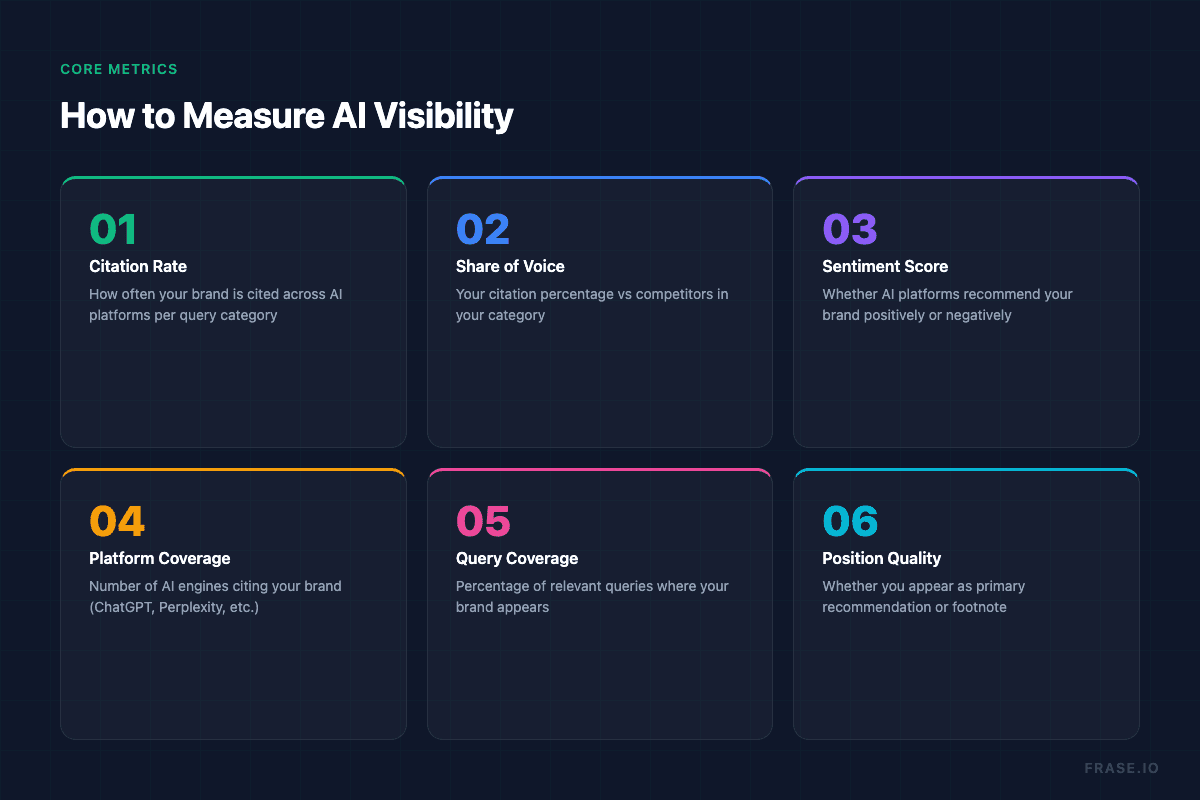
Measuring AI visibility requires a fundamentally different approach than measuring SEO performance. You cannot simply check a ranking position. Instead, you need to monitor whether AI platforms cite your brand across a range of relevant queries.
Key Metrics for AI Visibility
The most important AI visibility metrics fall into four categories:
1. Citation frequency
How often does your brand appear in AI-generated answers? Track this across individual platforms (ChatGPT, Perplexity, Google AI Overviews, Gemini, Claude, Copilot, Grok, DeepSeek) and as an aggregate score.
2. Share of voice
What percentage of AI answers in your topic area cite your brand versus competitors? This competitive benchmark is the AI equivalent of tracking market share in organic search.
3. Sentiment analysis
When AI platforms mention your brand, is the context positive, neutral, or negative? A brand mentioned only in the context of problems or complaints has "visibility" but not the right kind.
4. Query coverage
For what percentage of relevant queries does your brand appear? You might have strong visibility for "what is [your category]" but zero visibility for "best [your category] tools." Mapping your coverage reveals optimization opportunities.
Platform-Specific Measurement Challenges
Each AI platform presents unique measurement difficulties:
- ChatGPT does not provide a public API for monitoring citations at scale. Manual testing or third-party tools are required.
- Perplexity includes visible source links, making citation tracking somewhat easier, but query variation means comprehensive coverage requires systematic monitoring.
- Google AI Overviews appear dynamically and inconsistently across queries and geographies, requiring frequent checks across multiple search contexts.
- Newer platforms like Grok and DeepSeek have limited monitoring tool support.
How Frase Approaches AI Visibility Measurement
Frase's AI visibility tracking tools help content teams monitor their presence across AI search platforms. The platform integrates AI visibility tracking with content optimization, so you can identify gaps in your AI presence and immediately improve the content that is underperforming.
Here is what a comprehensive AI visibility measurement approach includes:
- Daily monitoring across multiple AI platforms to detect changes in citation patterns
- Competitive benchmarking to understand your share of voice relative to competitors
- Query mapping to identify which prompts trigger citations for your brand and where gaps exist
- Sentiment tracking to ensure your brand is mentioned in positive or neutral contexts
- Content attribution to connect specific pages on your site to their AI citations
For a deeper methodology on setting up AI search monitoring, see our guide on AI search tracking. To learn which specific queries to track, read what prompts to monitor for AI visibility.
Semrush, Ahrefs, and other established SEO platforms have begun adding AI visibility features. Semrush offers AI Overviews tracking within its Positions report. Ahrefs Brand Radar monitors more than 286 million prompts across AI platforms. These tools provide broad visibility reporting.
Frase differentiates by combining AI visibility monitoring with integrated content optimization. Rather than showing you that your visibility is low and leaving you to fix it elsewhere, Frase connects monitoring directly to the content optimization workflow needed to improve citations.
Track and improve your AI visibility with Frase:
- ✓ Monitor AI platforms daily
- ✓ Competitive share-of-voice benchmarking
- ✓ Integrated content optimization
Start Free Trial -->
Which AI Visibility Tools Should You Use?
The AI visibility tools market is evolving quickly. When evaluating tools, focus on these criteria:
Essential Criteria for AI Visibility Tools
Before selecting a tool, confirm it meets these requirements:
- Multi-platform coverage. The tool should monitor at least 4-5 AI platforms, not just Google AI Overviews.
- Query-level tracking. You need to see which specific queries trigger citations, not just aggregate scores.
- Competitive analysis. Understanding how you compare to competitors is essential for prioritization.
- Actionable insights. The best tools do not just report problems. They help you fix them.
- Update frequency. AI citation patterns change rapidly. Daily or near-daily updates are preferred over weekly snapshots.
Tool Comparison Overview
| Capability | Frase | Semrush | Ahrefs |
|---|---|---|---|
| AI platforms monitored | ChatGPT, Perplexity, Claude, Gemini and more | AI Overviews focus | 286M+ prompts |
| Update frequency | Daily | Varies by plan | Periodic |
| Competitive benchmarking | ✓ Share of voice | ✓ Visibility scores | ✓ Brand Radar |
| Content optimization | ✓ Integrated workflow | Separate module | Separate module |
| Sentiment analysis | ✓ | Limited | Limited |
| Best for | Content teams optimizing for AI | Broad SEO + AI visibility | Large-scale brand monitoring |
Most tools in this table hand you a dashboard and stop. Frase connects AI visibility tracking to SEO research, question research and content optimization in one workflow, so the gap you find on Monday is a drafted fix by Tuesday instead of a ticket for someone else.
For a detailed breakdown of all available options, see our complete AI visibility tools comparison.
If you want AI visibility data that arrives already attached to the work of fixing it — research, drafting, optimization and publishing in the same place — Frase is the strongest option on this list.
How Do You Improve Your AI Visibility?
Improving AI visibility requires a combination of content optimization, technical configuration, and strategic positioning. Here are the most effective strategies, organized by impact.
Content Optimization Strategies
1. Adopt answer-first content structure
Every page targeting AI visibility should provide a direct, concise answer to the primary query within the first 40-60 words. AI engines extract these opening statements for citations more frequently than buried answers.
2. Increase fact density with cited sources
Include a specific statistic, data point, or quantified claim every 150-200 words. Every data point should link to its primary source. AI engines prefer content that demonstrates factual rigor through cited research.
3. Use question-format headings
Write your H2 and H3 headings as questions that match how users query AI platforms. "How do you measure AI visibility?" is more likely to trigger a citation than "Measuring AI Visibility Methods."
4. Build comprehensive FAQ sections
Add 5-10 question-and-answer pairs at the bottom of pillar content. Use natural language questions with 40-60 word self-contained answers. Apply FAQ schema markup so AI engines and Google can parse these structured answers.
5. Create comparison tables
Structured comparison content is among the most frequently cited formats across AI platforms. Include at least one comparison table per pillar post.
6. Optimize for content quality and SEO
AI visibility and SEO are not competing priorities. High-ranking content is more likely to be cited by AI engines. Ensure your content scores well on topical coverage, keyword optimization, and readability using tools like Frase's content optimization features.
Technical Requirements
Content optimization alone is not sufficient. You also need to ensure AI engines can access and understand your content.
- Allow AI crawlers. Configure your robots.txt to permit GPTBot, PerplexityBot, ClaudeBot, and other AI crawlers. With 85% of top news sites blocking AI bots, allowing access gives you a competitive advantage.
- Implement schema markup. Use BlogPosting, FAQPage, BreadcrumbList, and HowTo schema types. Structured data helps AI engines parse your content more effectively.
- Ensure fast page loads. Pages that load slowly may not be fully crawled by AI bots. Target under 3 seconds for full page load.
- Use server-side rendering. Content hidden behind JavaScript may not be accessible to all AI crawlers. Ensure your primary content renders server-side.
Content Freshness and Updates
AI engines increasingly prioritize fresh content. Establish a regular update cadence for your most important pages:
- Monthly reviews of high-priority pages for outdated statistics or claims
- Quarterly content refreshes that add new data, examples, and sections
- Annual rewrites for pillar content to maintain comprehensive, current coverage
This practice of regular updates signals to AI engines that your content is maintained and trustworthy.
Building a Citation-Worthy Content Library
Individual page optimization is important, but AI visibility scales when you build a comprehensive content library around your core topics. AI engines are more likely to cite brands that demonstrate deep expertise across a topic cluster rather than brands with a single strong page.
Build your library systematically:
- Create a pillar page for each core topic (comprehensive, 4,000+ words)
- Publish 5-8 supporting articles that cover subtopics in depth
- Interlink the cluster so AI engines can follow the topical connections
- Add original data or research that only your brand can provide
- Update the entire cluster when significant developments occur
For example, a brand focused on AI visibility might build a cluster with a pillar guide (this article), supported by articles on AI search tracking, prompt monitoring, AI visibility tools, GEO strategy, and industry-specific guides. Each piece reinforces the others, and the collective authority makes every piece more likely to be cited.
This cluster approach aligns with how Frase structures content optimization. Using Frase's SEO research tools, you can analyze the topical coverage of your content versus competitors and identify gaps in your cluster that reduce AI citation potential.
How Does AI Visibility Differ by Industry?
AI visibility is not uniform across industries. The prevalence of AI Overviews, the competitive landscape for citations, and the user query patterns vary significantly by sector.
SaaS and Technology
SaaS brands face intense competition for AI visibility in "best tools" and "how to" queries. AI engines frequently cite comparison content, feature lists, and user review aggregators.
Key opportunity areas for SaaS:
- "Best [category] tools" queries where AI engines list and compare products
- "How to [task]" queries where your product is the solution
- "[Your product] vs [competitor]" queries that drive high-intent visibility
Strategy: focus on comprehensive comparison content, maintain up-to-date feature documentation, and publish original research or benchmarks. Create dedicated comparison pages for each major competitor. Ensure your pricing page includes structured data that AI engines can parse.
E-commerce
For e-commerce, AI visibility centers on product recommendations and buying guides. AI Overviews in retail and consumer electronics frequently cite product review sites and structured product data. Strategy: implement Product schema markup, create detailed buying guides, and ensure product descriptions include specific specifications and comparisons.
Healthcare and Medical
Healthcare has the highest AI Overview trigger rate of any industry, with 88% of healthcare queries generating AI Overviews. This makes AI visibility both a massive opportunity and a responsibility. Strategy: prioritize E-E-A-T signals (expert authors, cited medical sources), ensure medical accuracy, and use MedicalCondition and MedicalArticle schema types.
B2B Services
B2B services brands compete for visibility in complex, multi-step buyer journeys. AI engines cite thought leadership content, industry reports, and case studies. Strategy: publish original data and research, create detailed methodology content, and build authority through consistent publishing in your niche.
Publishing and Media
Publishers face a unique challenge: 85% of top news sites block AI bots, creating a strategic dilemma between protecting content and gaining AI visibility. Strategy: evaluate the traffic-versus-visibility tradeoff for your specific situation. Some publishers find that selective AI bot access to non-paywalled content drives meaningful brand awareness without cannibalizing subscription revenue.
How Do You Build an AI Visibility Program?
Building AI visibility is not a one-time project. It requires a systematic, ongoing program. Here is a 90-day roadmap for launching an AI visibility initiative.
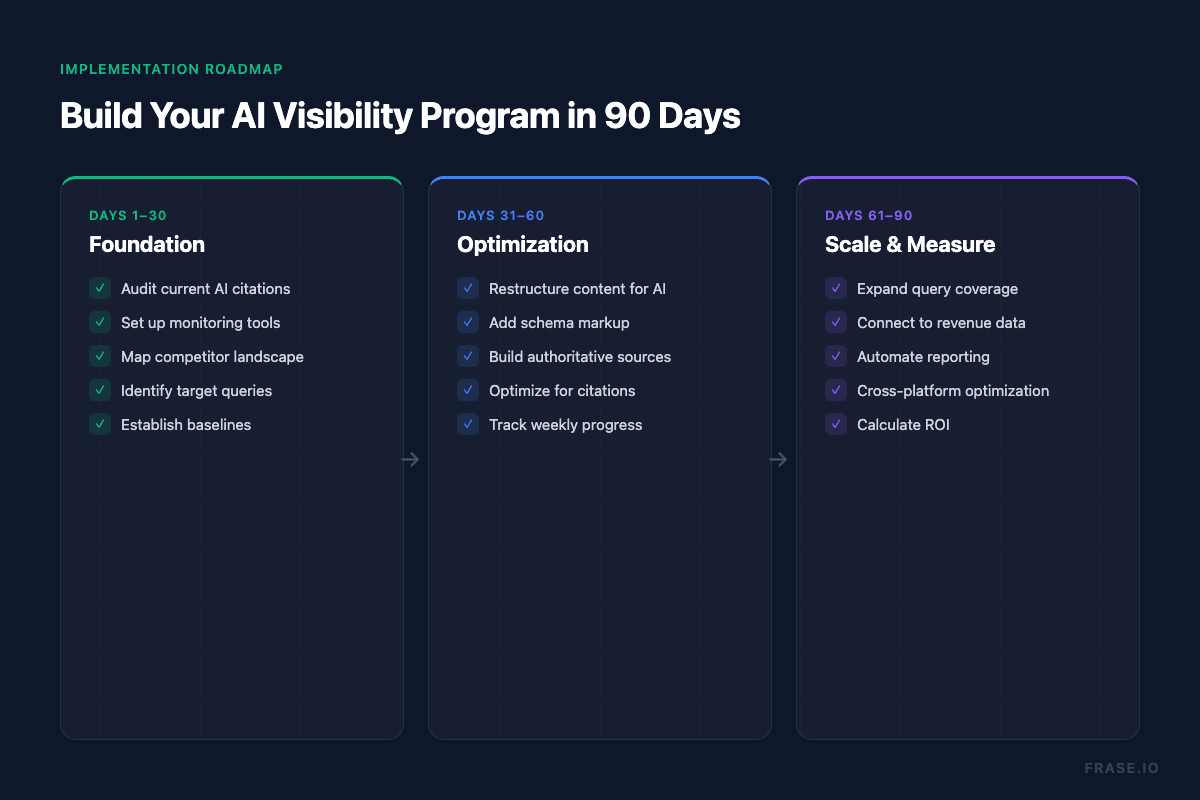
Days 1-30: Foundation
Audit your current AI visibility.
Test your brand name and your top 20 keywords across ChatGPT, Perplexity, Google AI Overviews, and Gemini. Document where you appear, where competitors appear, and where nobody appears.
Identify priority queries.
Map the questions your target audience asks that are most likely to trigger AI answers. Focus on informational and comparison queries. Use question research tools to discover the exact questions people ask about your topic.
Technical setup.
Verify that your robots.txt allows AI crawlers. Implement schema markup (Article, FAQ, BreadcrumbList) on your top 10 pages. Ensure your site loads fast and renders content server-side.
Deliverables by Day 30:
- Baseline AI visibility audit across 4+ platforms
- Priority query list (50-100 queries)
- Technical configuration complete
- Competitive visibility benchmarks
Days 31-60: Content Optimization
Optimize existing high-performing pages.
Start with pages that already rank well in Google, since top-ranking content has a higher likelihood of being cited by AI engines. Add answer-first introductions, increase fact density, implement FAQ sections, and apply schema markup.
Create new content targeting citation gaps.
For queries where no competitor has strong AI visibility, create comprehensive content designed specifically for AI citation. Use answer-first structure, heavy fact density, and comparison tables.
Establish an SEO content optimization process that incorporates AI optimization.
Update your content brief template to include AI visibility requirements: answer-first opening, question-format headings, fact density targets, and schema markup specifications.
Deliverables by Day 60:
- Top 10 pages optimized for AI visibility
- 3-5 new pages targeting citation gaps
- Updated content brief template
- Initial citation improvements measured
Days 61-90: Scale and Measure
Expand optimization across your content library.
Apply the optimization framework from Days 31-60 to your next tier of content. Prioritize pages by search volume, business value, and competitive opportunity.
Implement ongoing monitoring.
Set up daily or weekly AI visibility tracking across all priority queries and platforms. Compare your share of voice against competitors over time.
Measure ROI.
Connect AI visibility improvements to business outcomes. Track whether increased AI citations correlate with increases in branded search, direct traffic, demo requests, or trial signups.
Deliverables by Day 90:
- 25+ pages optimized for AI visibility
- Monitoring dashboard active
- ROI measurement framework in place
- Month-over-month visibility trends documented
ROI Measurement Framework
Measuring the return on AI visibility investment requires connecting citation data to downstream business metrics:
Before AI visibility program:
- 0 AI citations tracked
- Unknown brand presence in AI answers
- No competitive benchmarks
- Content optimized only for traditional SEO
After 90-day AI visibility program:
- Citations tracked across ChatGPT, Perplexity, Claude, Gemini and more daily
- Share of voice measured against top 5 competitors
- Content optimized for both SEO and AI visibility
- Direct correlation between citations and branded search growth
The key metric to watch: branded search volume. As your AI visibility increases, more users will search for your brand by name after encountering it in AI-generated answers. Track this in Google Search Console alongside your AI citation data to demonstrate clear ROI.
Connecting AI Visibility to Revenue
To build executive buy-in for AI visibility investment, connect citations to revenue through this attribution chain:
- AI citation detected for "[category] tools" query on ChatGPT
- Branded search increases as users who saw your citation Google your brand name
- Direct traffic grows to your website from users who remember your brand
- Demo requests or trial signups increase among users who discovered you through AI
- Revenue attribution from the AI-influenced pipeline
This is not a linear, deterministic path. AI visibility operates more like brand advertising than performance marketing. But the correlation between citation growth and branded search growth provides a measurable proxy for impact.
Track these leading indicators monthly:
- Branded search volume (Google Search Console)
- Direct traffic sessions (Google Analytics)
- "How did you hear about us?" survey responses mentioning AI
- Trial or demo conversion rates from branded search traffic
Frequently Asked Questions About AI Visibility
Is AI visibility the same as GEO (Generative Engine Optimization)?
AI visibility and GEO overlap but are not identical. AI visibility refers to the measurement and tracking of your brand's presence in AI-generated answers. GEO refers to the optimization strategies used to improve that presence. Think of AI visibility as the metric and GEO as the optimization practice.
Can you track AI visibility for free?
You can manually test queries in ChatGPT, Perplexity, and Google AI Overviews at no cost. However, manual monitoring does not scale. Free methods miss query variations, geographic differences, and day-to-day fluctuations. Dedicated AI visibility tools provide automated, comprehensive tracking that manual testing cannot replicate.
Does traditional SEO still matter if I focus on AI visibility?
Yes. Traditional SEO and AI visibility are complementary, not competing priorities. Content that ranks highly in Google is more likely to be cited by AI engines. Strong keyword research, quality backlinks, and technical SEO all contribute to AI visibility. The most effective strategy optimizes for both simultaneously.
How long does it take to improve AI visibility?
Most brands see initial improvements within 30-60 days of implementing AI visibility optimizations. Significant share-of-voice gains typically take 60-90 days. The timeline depends on your starting domain authority, content quality, and competitive landscape.
Which AI platform is most important for visibility?
For most brands in 2026, Google AI Overviews has the largest reach with 2 billion monthly users. ChatGPT has the fastest-growing user base at 910 million weekly active users. The ideal approach monitors all major platforms and optimizes content that performs well across multiple engines.
Should I block or allow AI crawlers?
Allow AI crawlers unless you have a specific content protection reason to block them. With 82% of top news sites blocking GPTBot, brands that allow crawling have less competition for citations. Allowing AI bots to index your content is a prerequisite for AI visibility.
How does AI visibility affect e-commerce businesses?
E-commerce brands benefit from AI visibility through product recommendations in AI answers. When AI engines cite your product pages in response to "best [product category]" queries, you gain exposure to high-intent buyers. Implement Product schema, create detailed comparison content, and maintain current pricing and specification data.
What is the difference between AI visibility and brand monitoring?
Brand monitoring tracks mentions of your brand across the web, social media, and press. AI visibility specifically tracks how AI search engines cite your brand in their generated responses. A brand monitoring tool might find a blog post mentioning you, while an AI visibility tool tracks whether ChatGPT or Perplexity mentions you when users ask relevant questions.
Ready to track and improve your AI visibility?
- ✓ 7-day free trial. No credit card required.
- ✓ Monitor AI platforms daily
- ✓ Competitive benchmarking and content optimization in one platform
About the author
Shegun Otulana
Founder & CEO
Shegun Otulana is CEO of Copysmith AI, parent company of Frase.io and Describely.ai. He's a serial entrepreneur with multiple exits and has been building companies at the intersection of search, marketing, SaaS, and artificial intelligence since 2013. Shegun writes about generative engine optimization, AI search, and the future of content marketing.
Related articles


See Frase run on your own content.
Research your market, draft in your voice, and track where you show up across Google and AI search. Start free.
Start free trial7-day free trial. No credit card.