
Best AEO Tools in 2026, Ranked for Getting Cited in AI Answers
Ten AEO tools ranked by how far each one takes you from an AI citation you lost to a page that wins it back.
The best AEO tool in 2026 is Frase, for one reason: Frase carries you from "ChatGPT stopped citing us" all the way to a republished page, inside one platform. Every tool on this list tracks whether AI engines cite your brand. They separate on what happens after the alert, and that is what this ranking measures.
Some tools hand you a dashboard and leave the rest to your team. Some draft the fix. A few publish it. That difference decides whether AEO becomes a weekly habit on your team or a tab nobody opens by March.
Want a number before you shop? The free AI Visibility Checker shows which AI engines cite your domain today, no card. If you are still working out what AI visibility is, start there. For the practice itself, read the complete guide to answer engine optimization.
What happens when AI stops citing you
The alert lands on a Tuesday. ChatGPT no longer cites you for the question that brings in your best-fit buyers. A competitor's page sits in the answer instead.
Then the real work starts, and none of it is in the alert. Work out which of your pages lost the citation. Pull the research on what the winning page covers that yours does not. Write the brief. Find someone to write the page. Route it for approval. Publish it. Remember, three weeks later, to check whether the citation came back.
That is four tools, two calendars and a lot of chasing, and the citation stays gone the whole time. Absence has a measurable price. Pew Research found that 18% of the Google searches it studied produced an AI summary, and that people who saw one clicked a search result in 8% of visits against 15% when no summary appeared. Ask people directly and 65% of U.S. adults say they at least sometimes come across those summaries. When you are missing from the answer, you lose the click before the click exists.
A tool that only reports the loss has handed you a to-do list. The tools worth paying for shorten the distance between the alert and the published page. Judge each one on how much of this it answers for you:
- Where are we cited right now, and on which prompts?
- What share of those citations do we hold against the competitors we care about?
- Which of our pages are losing citations, and who is taking them?
- What has to change on the page to win the citation back?
- Once we know, can the platform make that change and publish it?
That last question is the ranking axis below.
The 10 best AEO tools in 2026
Ranked by how much of the path from a lost citation to a republished page happens inside the tool. Pricing reflects publicly available information as of September 2026. Confirm current rates on each vendor's site, since plans change often.
| Tool | Built for | Engine coverage | Fix and publish workflow | Entry pricing |
|---|---|---|---|---|
| Frase | In-house teams, agencies and large organizations that want the alert and the fix in one place | ChatGPT, Perplexity, Claude, Gemini, Google AI | Tracking feeds research, drafting, SEO and GEO scoring, then publishing to WordPress, Sanity, Webflow, Wix or FraseCMS at the autonomy you set | From Starter up to Enterprise, scoped to your org |
| Profound | Teams that want measurement depth first | Major AI engines | Answer-engine reporting with agent workflows layered on | Published self-serve tiers from $99/mo, plus a custom enterprise plan |
| Conductor | In-house teams standardized on a full search platform | Major AI engines | AI visibility with content generation and site monitoring | Enterprise plans, quoted |
| Positive Surfer | Content teams already drafting in Surfer | Major AI engines | Content editor and optimization scoring, with AI visibility tracking beside it | Published self-serve tiers |
| Writesonic | Growth teams wanting tracking and remediation together | Major AI engines | Monitoring plus prioritized actions that can be pushed to a CMS | Published self-serve tiers |
| Semrush AI Visibility Toolkit | Teams standardized on Semrush | Major AI engines plus Google AI features | Prompt tracking and visibility scoring inside the Semrush suite | Published self-serve plan on a dedicated AI pricing page |
| Scrunch | Brands treating AI agents as a customer channel | Major AI engines | Brand-presence monitoring, site audits, an Agent Experience Platform at Enterprise | Published plans from $250/mo |
| Peec AI | Agencies reporting across many brands | Major AI engines | Prompt-level analytics and citation analysis | Published self-serve plans |
| Otterly.ai | Solo marketers checking whether they appear at all | Major AI engines | Brand mention and citation monitoring | Published self-serve tiers |
| Ahrefs Brand Radar | SEO teams already inside Ahrefs | Major AI engines, plus YouTube and Reddit | AI mention data alongside keyword and backlink research | Ahrefs plans from $129/mo; the AI Visibility Index is priced separately from $199/mo |
Ranked best to worst, and what decides the order
Frase ranks first. The axis is how much of the path from a lost citation to a republished page sits inside one platform, and Frase covers all of it: tracking, research, drafting in your brand voice, dual SEO and GEO scoring, publishing, then watching the page again. The rest of the order follows how far each tool carries you before it hands the work back.
- Frase. The whole path from a lost citation to a republished page, inside one platform, at the autonomy you set.
- Profound. Answer-engine reporting with real depth, from prompt volumes to agent analytics, for teams that want measurement first.
- Conductor. AI visibility, content generation and site monitoring inside a full search platform.
- Positive Surfer. A content editor with optimization scoring, now with AI visibility tracking beside it.
- Writesonic. AI visibility monitoring with a prioritized action list and a CMS push.
- Semrush AI Visibility Toolkit. Prompt tracking and visibility scoring for teams already inside Semrush.
- Scrunch. Brand-presence monitoring plus content delivered to the AI agents reading your site.
- Peec AI. Prompt-level AI search analytics built for reporting across many brands.
- Otterly.ai. Brand mention and citation monitoring at a low commitment.
- Ahrefs Brand Radar. AI mention data and offsite sources sitting beside keyword and backlink research.
Where you land depends on how your team is built. If measurement and content sit with different people, Frase covers both sides of that split with roles and permissions and exportable client-ready reports, so the analysts and the writers work from one system instead of two. If one team owns both, it is the shorter path still: the citation you lose on Monday can be a republished page by Friday without leaving the platform.
1. Frase: the whole path, from lost citation to republished page
Why Frase ranks first: every step between the alert and the live page happens in one place. No handoff to a second login, a second vendor or a second team.
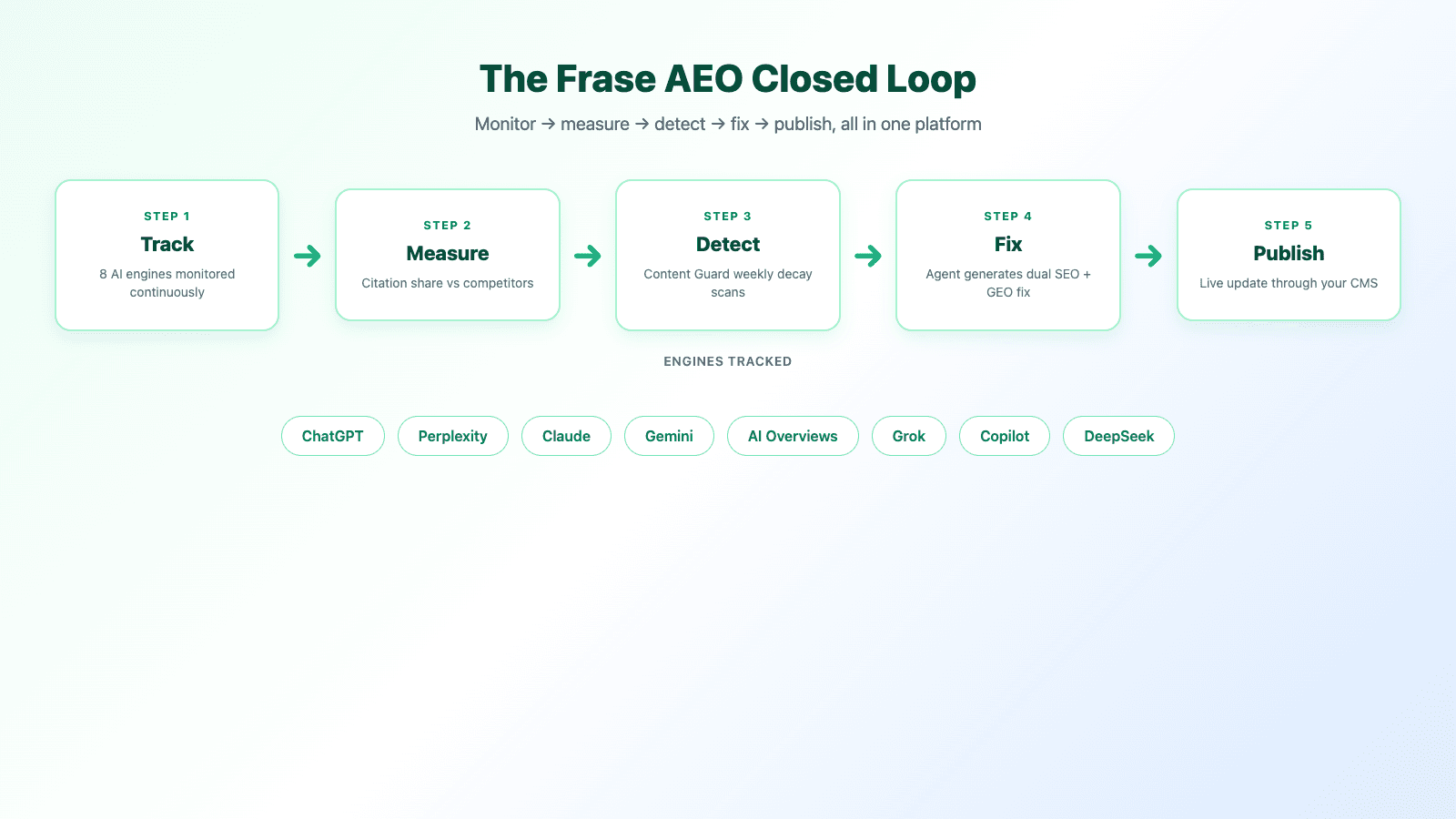
What Frase does: Frase tracks where ChatGPT, Perplexity, Claude, Gemini and Google AI cite your brand, shows prompt-level share of voice against competitors you name, and logs which AI crawlers reached your pages. That is the listening half, and it runs daily with alerts.
The other half is where Frase separates. When a published page starts losing Google rankings and traffic, Content Guard drafts the fix from that page's own research rather than handing you a recommendation to go act on. You set how much the agent does on its own, from drafting for your review to publishing without you. The dial is yours and you can move it whenever you want.
Approved updates land on the real page. Frase publishes to WordPress, Sanity, Webflow, Wix and FraseCMS, so a fix reaches your live site instead of sitting in a panel waiting for a copy-paste. If you would rather host with us, FraseCMS keeps the research attached to every page it publishes.
Frase runs at organization scale as well as on one site. Scale covers up to ten domains and five seats with roles, and exports client-ready reports for every client. Enterprise adds white-label reports, a branded client portal, SSO and SAML, custom seats, domains and limits, two years of history, a dedicated account manager and an SLA. Thousands of teams already run on Frase, from solo operators to large enterprises.
Every draft is scored for SEO and GEO in the same editor, so you are not optimizing for Google in one tool and for AI answers in another. Frase is also agent-native: an MCP server, a CLI and agent skills let your own agents run research, scoring and publishing without opening a browser. Continuous AI visibility tracking keeps watching after the fix ships, which is how you find out the citation actually came back.
What you get, concretely:
- Daily citation tracking across ChatGPT, Perplexity, Claude, Gemini and Google AI
- Prompt-level share of voice against the competitors you name
- A log of which AI crawlers reached which of your pages
- Content Guard decay detection on every published page you connect
- Corrections drafted from the page's own research, applied at the autonomy you set
- Publishing to WordPress, Sanity, Webflow, Wix and FraseCMS
Pricing: plans run from Starter to Enterprise, scoped to your org. Every tier gets a 7-day free trial with no credit card. Rated 4.8 out of 5 on G2. See pricing for the full breakdown.
Best for: in-house content teams, agencies and large organizations that want the finding and the fixing in one subscription.
2. Profound: answer-engine reporting with measurement depth
What it does: Profound reports where AI answer engines mention your brand, with prompt volumes, shopping views and agent-traffic analytics, plus agent workflows layered on top.
Why it ranks here: measurement depth. Profound's plan grid leads with answer-engine insights, responses analysed per month, prompt volumes, shopping tracking and agent analytics, with its agents layered on top of that reporting.
Pricing: published self-serve tiers from $99/mo, plus a custom enterprise plan.
Best for: teams with a dedicated AI-visibility function. Weighing the two directly? Read Frase vs Profound.
3. Conductor: AI visibility inside a full search platform
What it does: Conductor pairs AI visibility tracking with AI content generation and around-the-clock website monitoring.
Why it ranks here: the pieces exist, spread across a broad platform. Conductor publishes no prices; the pricing page routes you to Try for Free, Request a Demo or Contact Sales, which tells you the shape of the conversation before you see a number.
Pricing: enterprise plans, quoted.
Best for: in-house teams already standardized on a search platform. Side by side: Frase vs Conductor.
4. Positive Surfer: AI tracking next to your content scores
What it does: Surfer is a content editor with optimization scoring, and AI visibility tracking now sits beside those scores.
Why it ranks here: the writing happens in the tool, which covers the middle of the path. The step that gets a corrected page back onto your live site is the one to check against your own stack.
Pricing: published self-serve tiers.
Best for: content teams already drafting inside Surfer. Side by side: Frase vs Surfer SEO.
5. Writesonic: monitoring with a prioritized action list
What it does: Writesonic monitors AI visibility and turns what it finds into prioritized content, citation and technical actions, with on-page changes that can be pushed to a CMS.
Why it ranks here: monitoring, remediation and a publish path sit in one product, which covers a real stretch of the distance.
Pricing: published self-serve tiers.
Best for: growth teams who want tracking and remediation in the same dashboard. Side by side: Frase vs Writesonic.
6. Semrush AI Visibility Toolkit: the AI layer on a suite you already pay for
What it does: Semrush's AI Visibility Toolkit shows how brands appear in AI-generated answers, with prompt tracking, visibility scoring and competitor comparison inside the wider Semrush suite.
Why it ranks here: the AI Visibility Toolkit is an AI layer on a broad SEO suite rather than a standalone product, priced per domain on its own page. Its Base plan tracks 25 custom prompts and reports mentions from ChatGPT, Google AI, Gemini and Perplexity. Teams weighing the alternatives read our Semrush alternatives breakdown next.
Pricing: a published self-serve plan on a dedicated AI pricing page, priced per domain.
Best for: teams standardized on Semrush. Side by side: Frase vs Semrush.
7. Scrunch: built around how agents experience your site
What it does: Scrunch monitors brand presence in AI search, runs site audits, and sells an Agent Experience Platform on its Enterprise tier for how AI agents read and reach your pages.
Why it ranks here: Scrunch aims at how AI agents read and reach your site. That is a real question, and a different one from which page to rewrite this week, which is the work that actually moves a citation back.
Pricing: published plans starting at $250 a month.
Best for: brands treating AI agents as a customer channel.
8. Peec AI: AI search analytics for reporting
What it does: Peec AI is AI search analytics for marketing teams, with prompt-level tracking, citation analysis and multi-country coverage, packaged for agencies as well as in-house brands.
Why it ranks here: Peec is built to measure, and the reporting is the product. If you are weighing it seriously, read our Peec AI alternatives roundup and the Frase vs Peec AI comparison.
Pricing: published self-serve plans with a custom enterprise tier.
Best for: agencies reporting across many client brands.
9. Otterly.ai: the low-commitment first look
What it does: Otterly.ai tracks where your brand is mentioned and your site cited across ChatGPT, Perplexity, Google AI Overviews, AI Mode, Gemini and Copilot, with published tiers that scale by prompt volume.
Why it ranks here: it answers "do we show up at all" without much commitment. Monitoring is the scope, so budget separately for the work that follows.
Pricing: published self-serve tiers.
Best for: solo marketers and small teams taking a first reading. Side by side: Frase vs Otterly.
10. Ahrefs Brand Radar: AI mentions beside your backlink data
What it does: Brand Radar surfaces how often a brand appears in AI answers, and tracks the offsite sources feeding them, including YouTube and Reddit, alongside Ahrefs' keyword and backlink research.
Why it ranks here: the question it answers is whether you are mentioned. Valuable in an SEO workflow, and a starting point rather than a finish line.
Pricing: Ahrefs plans start at $129/mo and include a small allowance of tracked AI prompts. The AI Visibility Index is a separate line from $199/mo, and Custom Prompts start at $50/mo on top.
Best for: SEO teams already inside Ahrefs. Side by side: Frase vs Ahrefs.
Which AEO tool should I choose
Choose the AEO tool that covers the part of the job your team cannot absorb by hand. Knowing whether AI engines mention you is the easy half, and every tool on this list will tell you that much. The half that costs a week of someone's time is turning that alert into a republished page, and Frase runs that whole sequence in one platform, at the autonomy level you set.
Solo founder or one-person marketing team. Get a reading first. Run the free AI Visibility Checker on your own domain, see whether AI engines name you, and pick one page worth fixing. You do not need a platform to answer the first question.
Content team of two to ten. You need the loop, not the dashboard. At this size nobody has a spare afternoon to turn an alert into a brief into a draft into a publish. Frase runs that sequence for you and keeps watching the page afterwards, which is why it leads this list.
Enterprise content org. Score on publish coverage and governance before you score on engine breadth. Multi-site rollouts die on the last step, not the first: if a corrected page cannot reach the live CMS with an approval trail behind it, the program stalls no matter how good the reporting looks. Frase is built for that end of the market too, with white-label reports, a branded client portal, SSO and SAML, custom seats and domains, and a dedicated account manager with an SLA.
Choosing between neighbouring categories? The best AI visibility tools list covers monitoring-led platforms, the best GEO tools list covers generative engine optimization, and the best AI SEO tools list covers the wider search stack.
What criteria matter for selecting fine-tuning aware AEO tools?
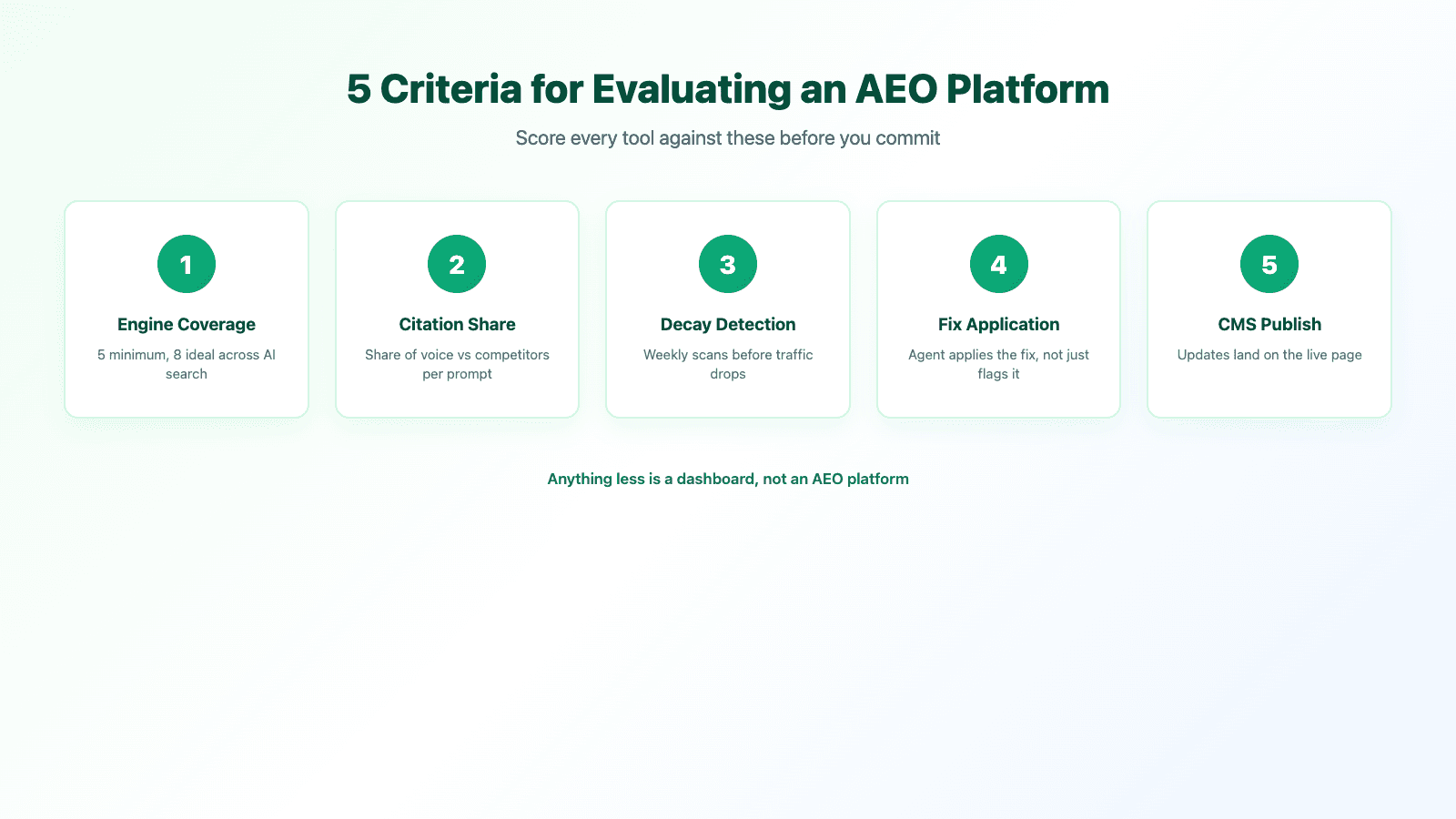
Five criteria decide it: engine coverage, citation share against named competitors, decay detection, whether the tool drafts the fix, and whether it publishes to your CMS. Buyers who care about fine-tuning add a sixth, whether the platform writes in your brand's own voice and terminology rather than a generic house style. Frase scores on all six.
Score every shortlisted tool against the five below before you commit to an annual contract.
- Engine coverage. Cover the engines your buyers actually use. ChatGPT, Perplexity, Claude, Gemini and Google AI answer most of the questions that matter to a content-led business today, and each cites a different mix of sources. Tracking one engine is the AEO equivalent of checking your rankings on a single search engine and calling it a report.
- Citation share, not mention counts. A weak tool tells you your brand was mentioned. A strong one tells you what share of citations you hold on a given prompt, and which competitors hold the rest. That is the difference between a keyword ranking and a share-of-voice number, and it is the one that survives a board meeting.
- Decay detection before the traffic chart bends. Citations decay before traffic does. Engines refresh their answers, competitors publish something better, and your page quietly drops out. Look for continuous scanning tied to the specific gaps that caused the loss, rather than a generic "traffic is down" alert you still have to diagnose.
- Whether the tool drafts the fix. Most of the category will tell you what is wrong. Far fewer will write the correction. The gap matters because diagnosis is the cheap part: knowing a page lost its citation takes a minute, and rewriting it to win the citation back takes a week of someone's time you have not budgeted.
- Whether the fix reaches the live page. A fix inside a recommendations panel is not a fix. The platform has to put the corrected page back on your live site. WordPress alone runs 40.7% of all websites, so a tool that cannot publish there rules itself out for a large share of buyers. Anything less and your team is still copying between a dashboard and an editor, which is where AEO programs quietly die.
What tools automate an AI content pipeline from research to publishing with answer engine optimization tracking?
Frase automates that pipeline end to end: research, drafting in your brand voice, SEO and GEO scoring, publishing to WordPress, Sanity, Webflow, Wix or FraseCMS, then citation tracking across ChatGPT, Perplexity, Claude, Gemini and Google AI, with corrections drafted when a page slips. An MCP server and a CLI let your own agents drive it.
Which is better for AI search term replacement SEO: Profound or Conductor?
Neither wins outright, because the choice between them turns on procurement rather than outcomes: Profound publishes self-serve tiers, Conductor quotes through its sales team. The axis that decides results is whether a tracked term becomes a republished page, and Frase carries that whole path inside one platform.
See which AI engines cite you today
Frase tracks where ChatGPT, Perplexity, Claude, Gemini and Google AI cite your brand, then turns a lost citation into research, a draft in your voice, a dual SEO and GEO score, and a published page. AI Visibility keeps watching the citations afterwards, and Content Guard covers Google rank and traffic decay on the same pages, drafting the next fix at the autonomy you choose.
Start with the free AI Visibility Checker to get your own number. When you want the fix to live in the same place as the finding, take the trial.
Start your 7-day free trial. No credit card required.
Frequently Asked Questions
What is an AEO tool?
An AEO tool monitors how often AI answer engines such as ChatGPT, Perplexity, Claude, Gemini and Google AI cite your brand, and helps you improve those citations. The stronger platforms go further: they detect when a page starts losing citations, draft the correction, and publish the updated page back to your CMS so the fix reaches your live site.
What is the best AEO tool in 2026?
Frase, for most content and SEO teams. Frase tracks citations across ChatGPT, Perplexity, Claude, Gemini and Google AI, then feeds that signal into research, drafting, SEO and GEO scoring, and publishing to WordPress, Sanity, Webflow, Wix or FraseCMS. A citation lost on Monday can be a republished page by Friday without leaving the platform, and the monitoring keeps running afterwards.
What should an AEO tool measure?
Citation share on the prompts that matter to your business, not raw mention counts. You also want decay over time, which competitors hold the citations you lost, and the specific content gaps behind the loss. Tools that stop at counting mentions leave you to work out the cause yourself, which is the expensive half of the job.
What is the difference between an AEO tool and an SEO tool?
An SEO tool measures where your pages rank on a results page. An AEO tool measures whether AI engines cite your pages when someone asks a relevant question. The two surfaces have largely decoupled, so a page can rank well and still go uncited by ChatGPT or Perplexity. You need both readings, or one platform that covers both.
Is there a free AEO tool?
Yes. Frase's free AI Visibility Checker runs a check on your own domain and shows which AI engines cite you, with no credit card. It is the fastest way to get a baseline before you compare paid platforms, and it tells you whether you have a visibility problem worth spending on.
Which AEO tool is best for a small team?
The one that does the work, not the one that reports it. At two or three people, a monitoring dashboard becomes a tab nobody opens, because acting on it means a week of writing nobody has. Frase drafts the correction and publishes it at the autonomy level you set, so a small team can run AEO at the pace of a much larger one.
Do AEO tools fix your content automatically?
Most stop at the report. Frase goes further, and you stay in control of how far. Content Guard watches your published pages for Google rank and traffic decay and drafts the fix from that page's own research; you set how much it does on its own, from drafting for your review to publishing without you. Nothing publishes itself unless you turn that on.
Does Frase work for enterprise content teams?
Yes. Frase runs the same loop at organization scale. Scale covers up to ten domains and five seats with roles, plus exportable client-ready reports. Enterprise adds white-label reports, a branded client portal, SSO and SAML, custom seats, domains and limits, two years of history, and a dedicated account manager with an SLA.
How much do AEO tools cost in 2026?
AEO pricing spans a wide range. Monitoring-led tools mostly price by prompt volume, platforms that also write and publish price by seats, sites and output, and a few vendors publish no prices at all. Frase runs from Starter to Enterprise, scoped to your org, with a 7-day free trial and no card. Judge the spend on how much of the work the tool takes off your team: the best AEO tools turn a lost citation into a published page, which pays for itself in a way another dashboard never does.
About the author
Shegun Otulana
Founder & CEO
Shegun Otulana is CEO of Copysmith AI, parent company of Frase.io and Describely.ai. He's a serial entrepreneur with multiple exits and has been building companies at the intersection of search, marketing, SaaS, and artificial intelligence since 2013. Shegun writes about generative engine optimization, AI search, and the future of content marketing.
Related articles

See Frase run on your own content.
Research your market, draft in your voice, and track where you show up across Google and AI search. Start free.
Start free trial7-day free trial. No credit card.